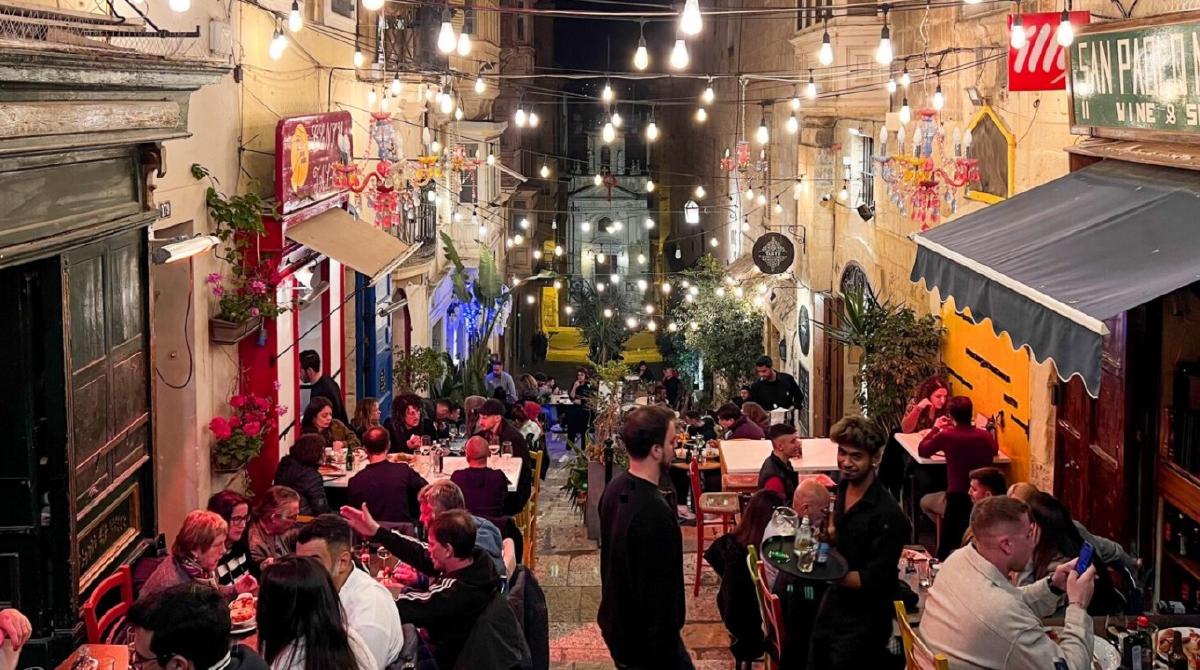
Maltese food is one of the surprises of a first Malta trip. People come for the limestone and the sea and end up texting friends about a 50-cent pastizzo from a Rabat hole-in-the-wall. The cuisine itself is a 5,000-year old layer cake — Phoenician fish, Arab spices, Sicilian pasta, Norman bread, North African pulses, British pies, Italian everything-since-1530 — and unlike the architecture, it doesn’t survive walking past it. You have to eat it.
A food tour gives you that, plus the why: why ftira is round and salty, why rabbit became the national dish (the Knights banned the locals from hunting anything else), why Maltese wine is suddenly worth taking seriously. Below is the honest comparison of every food tour worth booking, plus the DIY versions for each.
Some links below are affiliate links — they don’t change your price, and they help keep this guide running.
The seven types of Malta food tour#
| Type | Cost | Length | Best for |
|---|---|---|---|
| Valletta food walking tour | €55–70 | 3–3.5 hours | First-timers, single food booking |
| Mdina/Rabat food + wine | €60–85 | 3–4 hours | Slower-paced, wine angle |
| Marsaxlokk Sunday fish-market tour | €50–75 | 4 hours | Sunday-only, seafood lovers |
| Maltese cooking class | €85–120 | 3–5 hours | Hands-on, second food experience |
| Wine-region tour (Marsovin / Meridiana) | €65–95 | 4–5 hours | Wine drinkers, half-day inland |
| Gozo food + wine tour | €75–110 | 5–6 hours | If you’re already on Gozo |
| DIY food crawl (Valletta or Rabat) | €15–35 | Your pace | Budget, second food day |
1. Valletta food walking tour#
The most-booked food tour on the island and the right pick for most. 3–3.5 hours, 5–8 stops, small group (8–12 people). Standard route covers:
- Pastizzi at a working bakery — the Maltese national snack, layered pastry stuffed with ricotta or curried peas, eaten warm
- Ftira sandwich at a sandwich shop locals actually use — typically tuna, capers, olives, sundried tomatoes on a flat sourdough
- Hobż biż-żejt — Maltese open sandwich with tomato paste, capers, oil
- Bigilla — broad bean dip with garlic and chilli, scooped with galletti crackers
- Maltese wine and beer tasting — usually Marsovin red, Cisk lager
- A sweet stop: kannoli or figolli depending on the season, sometimes imqaret (deep-fried date pastries)
- Coffee + a final stop, sometimes with a fenkata (rabbit stew) sample
Valletta Food Walking Tour (5–8 Stops, Small Group)
3–3.5 hour small-group walking tour through Valletta. Pastizzi, ftira, bigilla, Maltese wine and beer tasting, plus a sweet stop and rabbit-stew sample on most operator versions. You’ll eat enough to skip lunch and renegotiate dinner — and walk away knowing what to order for the rest of the trip.
What’s included: all food and drink at every stop, a guide who’s usually a Maltese local (food guides on Malta tend to be passionate cooks moonlighting), 2.5 hours of walking with proper context.
What’s not included: transport (Valletta is small enough not to need it), tip (€5–10pp standard).
Pick this if: it’s your first Malta trip and you only book one food experience. Easy lunch replacement, easy way to learn what to order at every other meal of the trip.
Skip if: €60 feels steep — the DIY version (below) costs €15 and is honestly almost as good if you don’t need narration.
2. Mdina + Rabat food and wine tour#
Slower, less crowded, more wine. 3–4 hours, €60–85. Picks up in Mdina or includes transport from Sliema/Valletta. Stops typically:
- Crystal Palace in Rabat for pastizzi (the famous one)
- Fontanella in Mdina for cake on the bastion wall
- A wine tasting — sometimes at Meridiana or Marsovin vineyards if the operator includes a Ta’ Qali stop
- A long-form lunch at a Mdina or Rabat restaurant (rabbit, pasta, Maltese cheese)
Pick this if: you’ve already done Valletta, you’d rather a more sit-down food experience, or you specifically want the wine focus.
Skip if: you only have one tour day in Malta and you haven’t been to Valletta yet — the Valletta food tour is more iconic.
For wider Mdina options see best Mdina & Rabat tours from Valletta.
3. Marsaxlokk Sunday fish-market food tour#
Niche but fantastic if your trip lands on a Sunday. The Marsaxlokk fish market runs Sunday mornings only (07:00–13:00), and a few operators run combined market walk + waterfront fish lunch tours that cover:
- Fish-market walking tour with the guide explaining the species (lampuki, swordfish, octopus, the prawn boats)
- Local Marsaxlokk bakery stop
- Long lunch at a waterfront restaurant — typically Tartarun or Ir-Rizzu, both run by fishing families
Pick this if: your trip includes a Sunday and you like seafood. The market plus a long fish lunch on the waterfront is one of the best half-days on Malta — not just one of the best food half-days.
Skip if: you’re not in Malta on Sunday. The other six days the Marsaxlokk market is a small produce/tourist version, not the real one.
4. Maltese cooking class#
The “make-it-yourself” version of every other tour. 3–5 hours, €85–120, hosted in a real Maltese kitchen (Valletta, Mdina, sometimes a private home in a southern village). You’ll typically cook:
- Aljotta (Maltese fish soup) or kawlata (winter pork-and-veg stew)
- Ravjul (Maltese ricotta-stuffed ravioli) — rolling, filling, cutting from scratch
- Bragioli (beef olives in tomato gravy) or fenek (rabbit stew)
- Imqaret or kannoli for dessert
Then sit and eat what you made, usually with a glass of Maltese wine.
Pick this if: you’ve already done a food walking tour, you cook at home, or you’d rather a slower-paced food experience that doubles as lunch or dinner. Couples and small groups often rate this as the single best Malta booking they made.
Skip if: €95 feels steep, or you’d rather more variety than depth.
5. Wine-region day tour#
Malta has a small but serious wine industry — the two major producers are Marsovin (older, broader range) and Meridiana (newer, more boutique, in Ta’ Qali near Mdina). A half-day wine tour typically combines:
- A vineyard or winery tour with the cellar walk
- 4–6 wine tastings
- A cheese and charcuterie pairing
- Sometimes a stop in Mdina or Mosta on the same loop
Pick this if: you’re a wine drinker, you want to bring a bottle home, or your trip is in the harvest months (August–early October) when the vineyards are at their most photogenic.
Skip if: you’re not actually into wine. Maltese wines are good but not transformational; the food tours give you a sip without dedicating a half-day.
6. Gozo food + wine tour#
If you’re already on Gozo for a couple of nights, a dedicated Gozo food tour is the best half-day food booking on the islands — partly because Gozitan food is genuinely different (more cheese, more honey, more rural), and partly because Gozo’s pace makes a long tasting lunch feel right.
Typical stops:
- Ta’ Mena Estate vineyard or Ta’ Rikardu in the Citadel for sheep cheese and homemade Gozitan wine
- Maxokk Bakery in Nadur for ftira and Gozitan pizza-bread
- Savina Creativity Centre for Gozitan honey and prinjolata (Carnival cake) when in season
- A long lunch in Xagħra or Marsalforn
Pick this if: you have 2+ nights on Gozo, you want to come home with a story about Gozitan food specifically (not generic Maltese), and you don’t mind a slower pace.
Skip if: you’re doing Gozo as a single day-trip from Malta — too much to combine in one day. Compare day-trip formats in best Gozo day trips.
7. The DIY food crawl#
The honest take: a food tour is wonderful, but Maltese food is not gatekept. You can do a credible food crawl in Valletta or Rabat for €15–35 with a phone, a stomach, and a willingness to walk.
The DIY Valletta version (3 hours, ~€20pp):
- Crystal Palace, Rabat (35-min bus 51/52/53 detour, but worth it) — pastizzi, €0.50 each, 4 of them
- Nenu the Artisan Baker, Valletta — ftira, €8
- Caffè Cordina on Republic Street — coffee + imqaret, €5
- Trabuxu Wine Bar, Strait Street — Maltese wine flight, €12
- Legligin for an early small-plate dinner — bigilla, rabbit, octopus, ~€20pp
- Amorino for ice cream on the way out — €4
The DIY Marsaxlokk version (Sunday only, ~€35pp):
- Fish market walk 09:00–10:30
- Diar il-Bniet or Tartarun for the long fish lunch — €25–35pp
The trade-off: no narration, no “the reason this is shaped like that is because…” stuff, and you don’t get the small operators’ family-bakery stops that paid tours unlock. But the food itself is identical.
What food tours don’t cover (and where to go instead)#
Some of Malta’s best food experiences aren’t on tour rosters at all:
- Sunday rabbit lunch in Mġarr (Malta-side, not Gozo Mġarr) — book Ta’ L-Ingliz or United Bar & Restaurant a week ahead. €20–30pp, the most authentic fenkata you’ll find.
- Marsalforn waterfront dinner on Gozo — Otters or Tatita’s for fish, €30–50pp.
- Buskett Gardens picnic in spring — buy ftira at Maxokk or a Mdina bakery, eat under the orange trees. €5pp.
- Gozo cheese-shop crawl in Xagħra and Nadur — €10–20pp, no booking needed.
For deeper food coverage see traditional Maltese food: 15 dishes you have to try and best pastizzi in Malta.
When to book#
- Valletta food walking tour: 3–7 days ahead in summer; 2–3 days in shoulder season. Small group caps fill up.
- Cooking class: 5–10 days ahead — these often have 4-person minimums and 8-person caps.
- Marsaxlokk Sunday tour: 7+ days ahead — Sunday-only, limited departures.
- Wine tour: 3–5 days ahead, more if it’s harvest season.
- Gozo food tour: 3–5 days ahead in summer, often same-day in winter.
- DIY: no booking; pastizzi shops and Marsaxlokk restaurants take walk-ins for lunch (book the latter for dinner).
Insider tips#
- Crystal Palace in Rabat is cash only and has no seating. It’s a hole in the wall on Triq San Pawl. Pastizzi straight out of the oven, eaten standing up, €0.50 each. Worth a 30-minute bus ride.
- Maltese wine has gotten genuinely good. Try Marsovin Cassar de Malte (red), Meridiana Isis (white), and Antonin Gellewża (the indigenous red grape). The Cisk lager is fine, not exciting.
- Order rabbit stew for two even if you’re three. It comes in massive portions and you’ll have leftovers.
- The food tour is the lunch. Don’t book a big meal beforehand or after.
- Take a sweater for cooking classes in winter. Maltese kitchens often have stone floors and minimal heating.
- Gozo’s ftira is different from Malta’s. Gozitan ftira is more like a flatbread pizza (potato, tomato, anchovy) while Malta’s is the round sandwich loaf. Try both.
Common mistakes#
- Booking a food tour for the day you arrive. Jet lag + 3 hours of food + Maltese wine = early bedtime. Day 2 onwards is better.
- Going to Marsaxlokk on a non-Sunday and expecting the famous market. Mon–Sat is a small produce/tourist version, not the real fish market.
- Skipping the rabbit. It’s the national dish for a reason; it’s tender, slow-cooked in red wine and garlic, and not gamey at all if cooked properly.
- Booking a Valletta food tour and then a Valletta walking tour back-to-back the next day. The food tour already includes a lot of historical narration about the city. Do them at least a day apart, or pick one.
- Ordering “pasta” at a generic Sliema waterfront tourist restaurant. Pasta on Malta is great when it’s family-run; less great in 3-star hotel restaurants. Stick to fish, rabbit, and Maltese-specific dishes when in doubt.
- Forgetting to tip the food guide. Local guides earn a lot of their living from tips — €5–10 per person at the end is standard.
How food tours fit a wider Malta trip#
For most travellers, the food tour goes on Day 2 or Day 3 — after you’ve had one walking tour for context. In our itineraries:
- 3 days in Malta — Valletta food tour as Day 2 lunch replacement
- 5 days Malta + Gozo — Gozo food tour or cooking class on Day 4
- 7 days in Malta — Valletta food tour on Day 2, Gozo food tour on Day 6 if you want both
For other tour categories see best Malta tours or specifically best Valletta walking tours.
FAQ#
Is a Malta food tour worth it?#
For most first-timers, yes. Maltese food has 5,000 years of historical layering and almost none of it is signposted on menus. A 3-hour walking tour gets you context, six dishes, and a guide who’ll tell you what to order at every other meal of your trip. €60 for that is fair.
How long does a Valletta food tour take?#
Standard small-group food tours run 3–3.5 hours, with 5–8 food stops. Cooking classes run longer — 3–5 hours including the meal you eat at the end.
Should I eat before a food tour?#
No. Standard food tours are lunch-replacement portions — six small stops add up to a full meal. Eat a light breakfast, skip lunch, do the tour, eat a light dinner.
What’s the best food tour in Malta?#
For first-timers: a 3-hour Valletta food walking tour. Most variety, most iconic stops (Crystal Palace, Strait Street wine bars, a sweet stop). For a second food experience, a cooking class beats another walking tour — different format, deeper engagement.
Can I do a Malta food tour as a vegetarian?#
Most operators accommodate vegetarians with advance notice, but Maltese cuisine leans heavily on rabbit, fish, and pork. Vegetarian tours skip the rabbit-stew and fish-soup stops and substitute extra cheese, bigilla, and bread courses. Vegan: harder; ask the operator before booking.
Is the Marsaxlokk fish market worth a separate trip?#
If your trip includes a Sunday: yes, easily. Sunday morning between 09:00 and 11:00 is the fish market at its best. Other days the market is a smaller produce/tourist version that’s worth a stop only if you’re already in the south.
Can I drink Maltese tap water on a food tour?#
Yes — Malta’s tap water is desalinated and safe, though it tastes mineral-heavy and most locals drink filtered or bottled. Restaurants serve bottled water by default; ask for tap if you’d rather (it’s free and fine).
What’s the best Maltese wine to bring home?#
Marsovin Cassar de Malte (red) and Meridiana Isis (white) are the safe quality picks; Antonin Gellewża is the most distinctively Maltese red grape. €15–25 a bottle from a Marsovin shop in Valletta or directly from the wineries.
Last verified: April 2026. Operators, group caps and stop locations change — confirm on the operator’s page before booking.