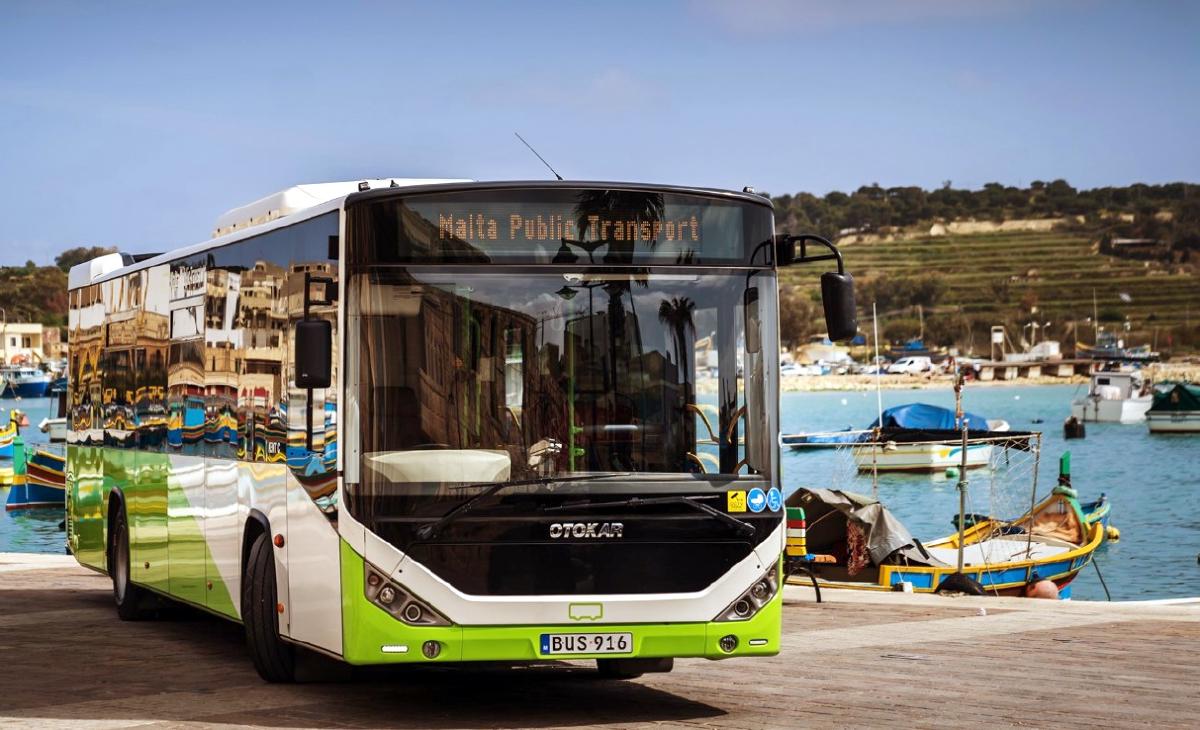
The Maltese bus network is the best transport bargain in the Mediterranean and one of the more confusing to use on Day 1. The fares change with the season, the cards have four different versions, the app is good but buried under a website that looks like 2014, and the buses themselves do not stop at stops unless you flag them down. Once you’ve got the rhythm, it’s brilliant. The first 24 hours are a learning curve.
Here’s the no-padding version of what to know.
Some links below are affiliate links — they don’t change your price.
Who runs the buses?#
The network is operated by Malta Public Transport under the Tallinja brand (pronounced tal-LIN-ya — it’s the Maltese word for “the line”). It covers all of Malta and Gozo, including Comino’s tiny year-round community via the Ċirkewwa shuttle. There’s no light rail, no underground, no tram — buses do everything.
Fares and cards: which one to buy#
Four ways to pay. Most travellers want option 2 or 3.
1. Single ticket on the bus#
- €2.50 from 15 June to 15 October.
- €1.50 from 16 October to 14 June.
- €3.00 for night routes (the N-prefix routes that run later, see below).
- Valid 2 hours, including transfers between buses going in the same direction.
- Pay with cash to the driver (have small change) or — easier — tap a contactless card or phone wallet at the Tallinja Tap & Go reader by the door. Tap & Go charges the same single fare and counts the 2-hour transfer window automatically.
2. Tallinja Explore Card (the one you probably want)#
- €21 for 7 consecutive days, unlimited rides on day routes.
- Buy at the airport ticket booth, the Valletta terminus, the Sliema Ferries office, or any of the larger interchanges.
- Pays for itself after 9 single rides in summer or 15 in winter — basically guaranteed for any 4+ day trip that includes Mdina, Marsaxlokk, or the airport.
3. Tallinja Explore Plus#
- €39 for 7 days unlimited buses + a few extras: the Sliema–Valletta and Three Cities ferries, the Hop-on Hop-off double-decker, the Valletta lift, and the Birgu little train.
- Worth it if you’re going to use the hop-on bus anyway. Otherwise the regular Explore Card + paying €1.50 each way for the ferry is cheaper.
4. Personalized Tallinja Card (locals + long-stayers)#
- €15 issuance + €0.75 per ride. Requires a residence-style registration with photo. Not relevant for a tourist trip — skip it.
How to actually catch a bus in Malta#
This is where most first-timers trip up.
1. Find your stop#
The Tallinja stops are pole-mounted signs with the route numbers listed. There’s no shelter at most of them. Use the Tallinja app (or Google Maps’ transit layer, which is accurate enough for Malta) to find the nearest stop and confirm route numbers.
2. Hail the bus#
This is the rule that catches everyone: drivers don’t stop unless you signal them. Stick your arm out, wave a bit, make eye contact — same as flagging a taxi back home. If you stand passively and watch the bus go past, the bus will go past. Even at busy stops, locals do a little wave.
3. Board through the front door#
Pay the driver in cash, tap your contactless card on the Tap & Go reader, or show your Explore Card to the driver (you don’t need to scan it — they look). Sit anywhere; rear and middle doors are exit-only.
4. Press the stop button#
Buses don’t auto-stop at every signed stop — you have to press the red STOP button on the handrails as you approach your destination. The button lights up for the driver. If you don’t press it and nobody else is getting off, the bus skips your stop. Annoying once, learned forever.
5. Exit through the middle or rear door#
Front door is for paying boarders only. The rear/middle doors open automatically once the bus stops.
The Tallinja app — actually useful#
The official Tallinja app (iOS and Android) does three things well:
- Live bus tracking — you can see where your bus is in real time and how late it is. Accuracy is solid most of the day, slightly less so during 16:00–18:00 traffic.
- Route planning — type origin and destination, get the best route plus walking directions to the stop.
- Top-up your Tallinja card — only relevant for the personalized card, not the Explore Card.
It’s not pretty, but it works. Google Maps also covers Malta’s bus network and is fine for basic A-to-B; the Tallinja app is better for live arrivals.
Routes you’ll actually use#
Bus numbers in Malta have a logic, mostly:
- 1–99: regular daytime routes
- X1–X4: airport expresses (no transfers needed, dedicated routes)
- TD1–TD12: direct routes (few stops between major hubs — fast)
- N1–N99: night routes (€3 fare)
The routes most tourists actually need:
| From | To | Routes | Time |
|---|---|---|---|
| Airport (MLA) | Sliema / St Julian’s | X2 | 35–45 min |
| Airport (MLA) | Valletta | X4 + walk | 30–40 min |
| Airport (MLA) | Buġibba / Qawra | X3 | 50–60 min |
| Airport (MLA) | Ċirkewwa (Gozo ferry) | X1 | 70–80 min |
| Sliema | Valletta | 13, 14, 15 (or use ferry) | 25–30 min |
| Sliema | Mdina / Rabat | 202 | 50–60 min |
| Valletta | Mdina / Rabat | 51, 52, 53 | 30–35 min |
| Valletta | Marsaxlokk | 81, 85 | 35–45 min |
| Valletta | Buġibba | 31, 41, 45 | 45–60 min |
| Sliema | Ċirkewwa (Gozo ferry) | 222 (cursed, see below) | 75–110 min |
| Sliema | Golden Bay | 223 | 60–75 min |
| Buġibba | Mellieħa / Ċirkewwa | 221, 222 | 30–40 min |
For airport-specific timing, see our Malta airport transfer guide.
About route 222#
The 222 is the bus from Sliema/St Julian’s to Mellieħa and Ċirkewwa. On paper it’s an hour. In summer traffic — particularly on weekends, August evenings, and any day a cruise ship dumps 3,000 people on the same route — it’s regularly 90 to 120 minutes. We don’t take it. Either:
- Catch the X1 from the airport on arrival day (faster, no Sliema bottleneck), or
- Take a Bolt to Ċirkewwa (€25–30 from Sliema, 35–45 minutes), or
- Bus to Buġibba (faster) and pick up the 221 from there for the last leg.
Late-night options#
Day buses run roughly 05:30 to 23:00, depending on the route. After that:
- Night routes (N1, N11, N13, N32, N52, N71, N81) run on Friday and Saturday nights and connect Paceville/St Julian’s to most main areas until ~04:00. €3 fare.
- Bolt and eCabs run 24/7 — you’ll need them on weekday late nights. Budget €15–25 for cross-island runs after midnight (with surge).
- The Sliema–Valletta ferry stops around 23:00, sometimes earlier in winter — confirm at the dock, not in your head.
Bus etiquette in Malta#
- Hail the bus as it approaches.
- Have your card or change ready before boarding. The line behind you will judge.
- Press the stop button before your stop.
- Don’t expect drivers to wait if you’re not at the door when the bus stops — they will close and go.
- No drinking, eating, or smoking on the bus.
- Backpacks off in crowded buses — wear them on your front or hold them. Standard EU bus manners.
- Standing room is normal in summer. The X-buses and the 222 are routinely standing-only.
Where the bus is genuinely worse than a Bolt#
Public transport here is excellent value but it has clear limits. Bolt is faster and saner when:
- You’re going to Ċirkewwa from Sliema (route 222 problem above).
- You’re carrying two big suitcases at the airport at 1am.
- You’re in a group of 3+ — the Bolt cost split is usually only marginally more than three single tickets.
- You’re going to a tour pickup with a hard start time.
- You’re returning from St Paul’s / Mdina at 22:30 when buses are sparse.
For everything else — Mdina, Marsaxlokk, Sliema-to-Valletta, anywhere on the day-tour circuit — the bus is fine.
If you really don’t want to bus#
The Hop-On Hop-Off double-decker is a tourist-targeted alternative that covers most of Malta’s main sights on a north and south loop, with multilingual audio commentary. Two-day tickets are around €40 and you can use it as transport between sights.
It’s not as cheap as the Tallinja Explore Card per kilometre, but it does fewer transfers, has commentary, and you get a roof seat with a view.
Common rookie mistakes#
- Standing at the stop without flagging the bus. It will drive past. Always hail.
- Forgetting to press the stop button. The bus skips your stop. Get used to pressing it as soon as the previous stop’s announcement goes off.
- Treating the timetable as gospel. Use the live app instead. Buses can run 5–15 minutes late on busy routes.
- Trying to pay the driver with a €50 note. Most drivers will refuse it. Bring small euros, or just use Tap & Go.
- Taking the 222 to make a ferry connection in summer. Don’t.
- Assuming the last bus is at midnight. Most routes end at ~23:00. Confirm before counting on it.
- Not knowing about the summer fare bump. €2.50 from 15 June to 15 October catches a lot of travellers off-guard.
FAQ#
How much does a single bus ticket cost in Malta?#
€2.50 from 15 June to 15 October (summer), €1.50 the rest of the year (winter). Night routes (N-prefix) cost €3 year-round. Tickets are valid 2 hours including transfers.
Is the Tallinja Explore Card worth it?#
For most stays of 4+ days, yes. The €21 / 7-day card pays off after 9 single rides in summer or 15 in winter — easily reached on a typical Mdina + airport + south-coast itinerary. For 1–3 day trips, just tap a contactless card via Tap & Go.
Where can I buy the Tallinja Explore Card?#
At the airport ticket booth (outside arrivals), the Valletta bus terminus, the Sliema Ferries office, and most major interchanges. You can also buy it online via the Tallinja site, but for tourists it’s faster to pick it up on arrival.
Can I pay with contactless or Apple Pay on the bus?#
Yes — the Tallinja Tap & Go reader by the front door accepts contactless Mastercard / Visa, Apple Pay and Google Pay. It charges the standard single fare and tracks your 2-hour transfer window automatically. No app required.
How late do buses run in Malta?#
Most day routes end around 23:00. Friday and Saturday nights have night routes (N-prefix) running until ~04:00 between Paceville and main areas. Weekday late nights you’ll need Bolt or eCabs.
Do Malta buses stop automatically at every stop?#
No — drivers only stop if (a) someone hails the bus from the stop, or (b) someone on the bus has pressed the STOP button. If neither happens, the bus skips the stop.
Is there a bus from Malta Airport directly to Sliema?#
Yes — the X2 Tallinja express runs MLA → Msida → Sliema → St Julian’s → Pembroke every 30 minutes during the day. €2.50 / €1.50 depending on season. See our airport transfer guide for all options.
Can I use Tallinja buses on Gozo?#
Yes — Gozo has its own network of Tallinja-operated routes connecting Mġarr (the ferry port) to Victoria, the Citadel, Ramla Bay, Marsalforn and Xlendi. The same fares and Explore Card apply. See Malta to Gozo ferry for ferry timings.
What’s the fastest way from Sliema to Valletta?#
The Sliema–Valletta ferry, hands down. €1.50 single, every 30 minutes, 10-minute crossing, with views of the bastions. Buses 13, 14, 15 do the same trip in 25–30 minutes overland and aren’t faster.
Last verified: April 2026. Tallinja routes occasionally change — check the Tallinja app or malta public transport’s official site before relying on a specific route number.